
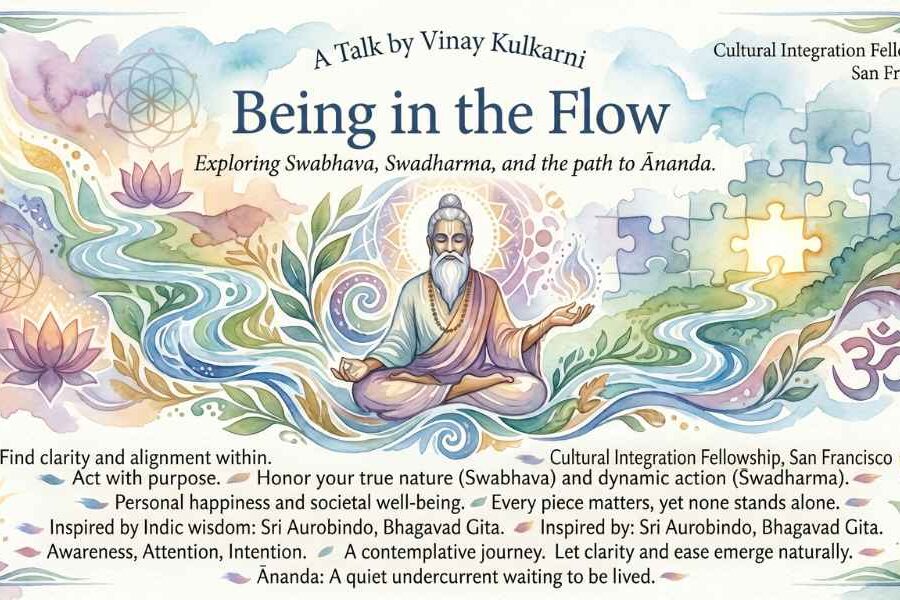
Introduction by Dr. Kundan Singh
Today’s talk, as you must have seen in the announcement, is titled “Being in Flow,” and it will be delivered by Vinay Kulkarni, who is a thought leader, entrepreneur, adviser, educator, and marketer with over 25 years of global experience in business management and wellness.
As a business transformation expert and Dharmik Innovation champion, he created the Dharmik Enterprise framework—a model that helps organizations align profit with purpose and evolve into Dharmik organizations.
Through his ventures and initiatives—Alchemy (A-L-C-H-M-I), Shankara Goodshala, Sanatani.com, and Upadesha Academy—he applies Dharmic principles to modern business education and governance, guiding people to design lives and systems that serve both society and the planet. Grounded yet forward-looking, his work blends clarity, compassion, and conscious action, making ancient Dharmic wisdom relevant for today’s world. He lives in Bangalore, India, and serves the world from there.
I’m taking this opportunity to introduce Vinay to our community, and before I hand the screen to him, I want to read a poem from the collection of Dr. Hyas Chauri titled The Rhythm of Truths. The poem is titled “Diversity.” I have a hunch that it will tie up quite nicely with today’s topic:ß
Some praise the being of old, Some pay homage to the coming new, Some affirm the truth as eternal fact, Some conceive it as continuous act. Some love to worship timeless perfection, Some glorify unceasing evolution. Some take delight in static contemplation, Some are sick with vigorous action. Some pin their faith on lofty abstraction, Some are wedded to sensuous perception. Some are enamored of the highly mystical, Some insist on the clear-cut logical. Some tread the path of complete negation, Some indulge in increasing affirmation.
Multicolored is indeed human personality. Multiform is the richness of ultimate reality.
Very nice. Thank you very much for joining us. Over to you.
The Talk: Being in Flow
Thank you so much for the introduction.
I had originally titled this “Being in Flow with Swabhava and Swadharma,” and I’ll tell you why I’m mentioning this. Kundan Ji changed it to simply “Being in Flow”—that made a big difference and actually gave new shape and direction to the whole talk. It’s a good example of being in flow, because I just took that and went with it. It gave me something.
I’m using the river as a metaphor for what I want to convey today. We’ve all seen a river in perfect flow, right? We’ve also seen rivers that are flooded and, though perhaps not as commonly, rivers drying up or in drought situations. But I’m thinking of those beautiful rivers in Montana—maybe you’ve seen the movie A River Runs Through It. I’m thinking of a very gentle flow with clean, transparent water where you can actually see the riverbed and the rocks and pebbles underneath. There’s a lake in India where you can see all the fish and everything beneath the surface. I’m picturing a very transparent, clear river flowing gently and soaking in everything—the sun, the forest, everything. It flows very naturally and creates that beautiful sound rivers make.
Now imagine that river is you. Imagine you’re flowing—not forced, not frozen—just unfolding. So the whole thought was: how do you become that river? This question has interested me since childhood.
In school, I noticed something interesting. When you’d meet friends, parents were always asking, “What is your child going to become?” The child might be only five or six years old, and they’re already talking about the future. I also noticed that many children start figuring out early—”I’m going to be a fighter pilot,” “I’m going to be an accountant,” and so on. Sometimes I wondered: how can this person have so much clarity about what they’re going to become when we’re just starting off and don’t know anything?
Fast forward to 2022-2023. I was talking to the head of HR for a very large global corporation, and she told me their employee helpline is always busy. They get many calls from young employees, and a lot of these calls involve people having suicidal thoughts. I asked what she thought was causing this. She said these were people who did very well in school and college, got well-paying jobs, bought houses, bought cars, got married, had kids—and then suddenly realized they didn’t really enjoy what they were doing. They felt stuck and suffocated, not getting joy from their lives. They were trapped in that feeling.
I’m giving you various things here to put it all together and give context for what I’m talking about.
If I were to quote Charles Dickens and say these are “the best of times and the worst of times,” I wouldn’t be far off, right? We’ve got so much going on. The AI revolution is underway—some say it’s great, others aren’t sure where it’s going. China has two million robots right now, more than any other country, and Elon Musk has his own plans for populating Earth with more robots. Children are growing up with everyone having a best friend now called ChatGPT. Earlier, they’d go to parents or teachers when in trouble. Now they go to ChatGPT, and the number of ChatGPT-assisted suicides has also grown. Even the old Chinese curse—”may you live in interesting times”—seems apt. We are living in very interesting times.
With so much technology and everything going on, I saw an interview with Vinod Khosla talking about how AI will change the world. He said basically there’s going to be no limit to production with AI and robots together. So the world economics as we know it is going to change.
With all this happening, why are the questions that Arjuna asked Krishna on the battlefield of Kurukshetra still relevant? How come the same questions persist? It’s almost like the actual tables—they give you all the stats in the world, but they can’t tell you anything specific about you, right? We have all this information, but the human dilemma and human questions remain. I can’t say unanswered, but everyone has to answer for themselves.
There’s so much focus on the external world and external situations that we’ve completely neglected our inner world, our inner questions. In Zen, they say if you meet Buddha in the marketplace, kill him. Buddha’s enlightenment solved his problem. Now you go and solve your own problem. Somebody else’s enlightenment isn’t going to solve your problems. You’re still left with the basic questions about yourself that ChatGPT cannot answer, no matter how advanced it gets.
Let me give you a few more data points. I was talking to the chief medical officer at a wellness center this morning, and he referred me to a book called The Radical Remission, where a doctor studied several thousand cancer patients who recovered completely. They couldn’t figure out why initially. She did a study and found 75 factors that led to remission. Out of that, nine were most important, and of the nine, the last one was purpose— purpose of life.
During my fifteen years in the US, I met many very successful businesspeople. From the outside, everything looked great. They lived in big homes, drove great cars, had everything. But in private conversations, there was strife, struggle, internal hardship. My observation was that they had accomplished their purpose—they had a purpose and had achieved it. But it was an externally imposed purpose, something planted in their mind by their parents or something society put in front of them. It wasn’t their inner thing.
In my school, we had a student who was always the topper. His parents made sure he got first rank every time.
Otherwise, there were consequences at home. He studied very hard, did great, got into the Indian Institute of Technology, did well there, then went to the University of California, Santa Barbara, and did his PhD there. On one of my visits to India, I ran into his parents, and they said, “You’ve got to do something. What happened? He came back from Santa Barbara and now he’s doing organic farming on somebody’s farm.”
I came to know through mutual friends that he said, “I’ve done everything my parents wanted. Now I want to do what I want to do.”
There are so many cases like this. These are all cases where people were not in flow with their own Swadharma.
Understanding Swabhava and Swadharma
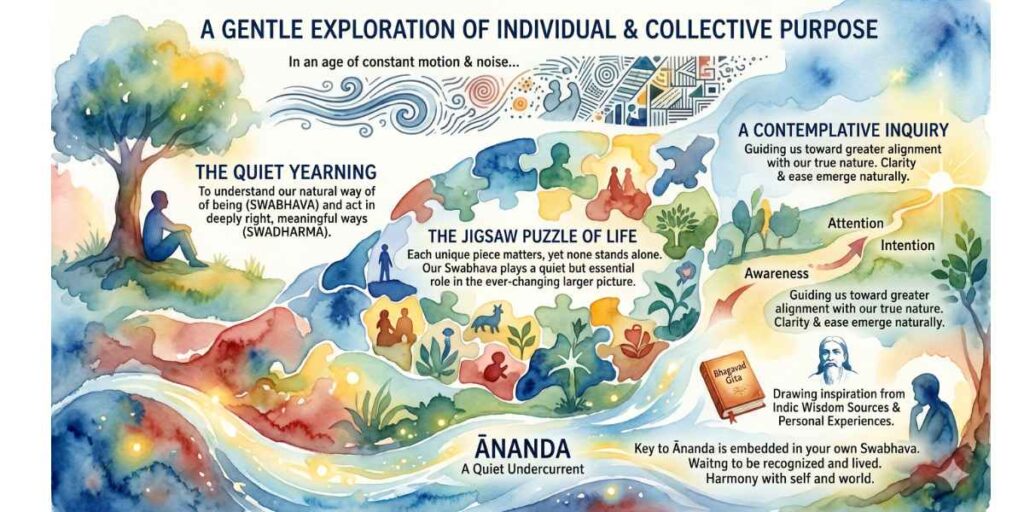
So, we had to come back and define this, which starts with understanding your own Swabhava—which is a little different from what we call personality. We don’t have time to go into all the factors that make up Swabhava and how it actually comes about. But we can understand that everyone has an innate nature they’re born with, very unique to that person. One of the important tasks of your life would be to discover your own Swabhava. What is it, and how do you do that?
We talked about how the river looks when it’s beautiful and when it’s in flow. You’ve seen sportspeople when they’re in flow—the whole stadium is enjoying that. When a great actor delivers a great performance worthy of an Oscar, millions of people around the world are enjoying it. But first, that actor had to create that enjoyment inside themselves. They’re enjoying doing it, and others are enjoying seeing them enjoy themselves.
When a chef really enjoys cooking, that meal feeds the whole restaurant with that joy. You’re cooking the joy and serving the joy, and others are eating the joy. Fundamentally, when you’re aligned with what you do, it creates joy.
As they say, “a thing of beauty is a joy forever.” In one sense, it’s very hard to know your Swabhava. In another sense, it may not be so hard. Some indicators are: what is easy, effortless, enjoyable, and ethical—and energizing, right? Because when you do something that is really aligned with your Swabhava, it gives energy back to you. It doesn’t take energy; it gives it back.
I discovered that my daughter was going to be a dancer when she was only six months old. I was playing music in the house, and she was in her crib. I played some music, and she started swaying her body. I changed the music, and she swayed differently. I changed it again, and her rhythm changed. I said, “Okay, she’s got kinesthetic intelligence.”
Just this July, a few months ago, she did a solo stage performance for a couple of hours in front of 400 people. She’s thirteen. She’s already a professional dancer with several performances every month. But she doesn’t like math, social studies, civics—all that. I said, “We’ll do homeschooling. Don’t worry about school. Just flow with what comes naturally to you.” She loves music and is a very good singer. Even after doing all her performances, when she comes home, she still does her dance practice before going to sleep. We never have to tell her, “Please dance” or “You missed your dance today.” In fact, we end up requesting her to rest a little.
There’s really no effort. It’s effortless, not only for her but for us too. It’s easy—she never walks; she just dances. You’d never see her walk. She’s always dancing. That gives her so much enjoyment. If her mood is down or something has happened, her answer to everything is dance. She’ll go and dance and find her answers through dance.
That’s what I’m talking about—being in that kind of flow. You’d wonder: after a very tiring stage performance and traveling for several hours in traffic, how can you still dance? Because it gives you energy. It’s not taking energy away from you. For those watching, it’s also so much joy. There’s a transference of that same thing.
In a sense, these people are going into what we call Samadhi. That’s what a classical Indian dance performance is supposed to be—the dancer goes into Samadhi and isn’t even aware of the audience. The audience is supposed to be looking at the dancer through a keyhole, seeing the dancer in Samadhi. Through the mirror neuron effect, the audience also goes into Samadhi.
When you’re in flow, you can help millions of people flow with you. It’s like a joint, collaborative effort.
On the other hand, I’ve been to performances where the dancer is really struggling, and she knows she’s struggling. The crowd knows she’s struggling. It’s embarrassing for her and painful for the audience. I’m thinking of the movie Amadeus, where there’s a kind of war between Mozart and Salieri. Mozart is a natural genius; Salieri is not, but he wants to be. He craves the adulation and praise that Mozart gets. So there’s a conflict between what you are and what you want to be, not accepting what you really are. He’s an example of someone not in flow, not only stuck but unable to contribute positively to organizations and other people. Because you can only give what you have. If you’re not cooking that joy inside you every day, you don’t have anything to distribute or share. In fact, you’re sucking everything from around you.
There was a documentary called Living to 90 about the blue zones. One of the factors they found, in addition to all the other social and community factors, was again having a purpose.
Flow and Sustainability
Let’s look at a few other aspects of what flow looks like. It’s not only authentic but also sustainable. Everybody’s talking about sustainability these days—sustaining the planet. But we haven’t addressed how a person sustains themselves. The only way we’ve defined sustenance is through whether someone has enough money, right?
But in a strange way, the alignment between Swabhava and Swadharma is also related to sustainability. It’s the only sustainable way for an individual to really live and enjoy life. When an individual figures this out and builds a family around that knowledge and awareness, they allow their family to also pursue their own Swabhava and Swadharma. A person who’s figured this out won’t impose their ideas on the rest of the world.
They’ll be curious about helping you discover your Swabhava and Swadharma just as they did for themselves. Because that also gives somebody joy—seeing someone discover their Swadharma, seeing someone discover and grow their talent in dance or whatever else. It’s joyful when someone is also on the same path.
If we build families based on this idea of sustainability, then society also becomes sustainable on a long-term basis. It’s natural.
Understanding Rta and Dharma
We also have this term called Rta—the natural cosmic order. Ritual also comes from that root. Without going into the technicalities, let me give an example of your car. Many cars run on the Otto cycle engine. You can’t see the cycle; you can’t touch it. But if that cycle breaks, your engine will break and cease. Your whole transportation system comes to a stop. There are natural governing principles for the whole universe as well, which we may not be able to see and touch, but they are there.
When our ancestors discovered this, they asked, “Okay, there’s a beautiful game already going on. So much fantastic stuff is already happening. What is my role in this, and how can I contribute to it?” The first thing is a feeling that I want to contribute to making this better, not destroying it. What is my role? That’s where the idea of Dharma comes into play.
In the process of discovering your own Dharma and flow, we must make sure we’re not trampling on others. To help with that, there are some common principles—what we call Samanya Dharma—things everyone should follow so that the whole social order can be sustained. You all obviously know the Yamas and Niyamas. Those are some examples. There are others too: Dhiti (patience), forgiveness, Dama (balance), Asteya (non-stealing), Akroda (non-anger). These are some common principles that must be followed.
Why are these important? Discovering your flow is one thing. Sustaining that flow is another. Some things can obstruct your flow, so those factors must be removed.
Ultimately, we’re talking about this river joining the ocean—this individual consciousness merging with universal consciousness, cosmic consciousness. That’s where we’re going. The cosmic purpose and the material purpose – both must be balanced.
We refer to this duo as Abhyudaya and Nishreyas—material prosperity and spiritual growth. My guru calls it “200 percent life”—100 percent material and 100 percent spiritual simultaneously. We experience everything the world has to offer, and at the same time, we have that cosmic goal in mind.
The Question of Time
As we go through this, how do we achieve this balance? Isn’t it too much? We’re not even able to live 50 percent of life. People don’t have time for 25 percent of life. Most time goes into work. Where is the time to do all this?
That’s where Swabhava and Swadharma aligned come in. Your Swadharma gives you—some people say Swabhava is very restrictive. I’m not happy with what I’m born with; I’m not happy with who I am, without even having discovered who I am. And I want to change. There are so many techniques, and so many people offering to help you change.
But there are two terms from Kashmir Shaivism that really resonated with me: Swatantra and Swachanda— freedom and the free flow. To achieve that, you’re going to have to work not on changing yourself but on accepting yourself as you are. At the same time, you’re working on the other factors that limit your spiritual progress.
Fundamentally, everyone is dealing with uncontrolled desire, anger, greed—the things you can reference in the seven sins if you want. These all hamper the flow—flow towards the ocean.
Here’s something very interesting: we have so many rivers in India and the US. To the naked eye, they’re all just rivers, all water. But scientists have found that each river has its own quality. The water from every river is different; each river has its own personality and flow.
When you discover that special thing about yourself, it somehow aligns with the cosmic goal as well. Truly discovering Swabhava—after removing all the layers that you’re not and after carefully weeding out the ego driven purposes and goals—leaves you with what Sri Aurobindo talks about: the divinity has embedded that whole purpose inside you already. Once you figure that out, the material and spiritual lives align, and they become one. It’s almost like there are two rivers in you that join and become one. The point where they meet.
This comes from my personal experience. In the beginning, there was a severe conflict between the spiritual and material for me. When I went to my first spiritual retreat, they had a Kirlian photography machine. My aura photography showed my higher chakras in the 90s and lower chakras in the 20s and 30s. There was a severe conflict.
After nine days of Sadhana, where my guru removed that conflict from my mind and helped me understand, the conflict resolved. On the ninth day, we did the photography again. The lower chakras had balanced with the higher chakras.
It’s this balance between Abhyudaya (material prosperity) and Nishreyas (spiritual growth). Both must be aligned, and that happens when you find your Swabhava and Swadharma.
Questions and Dialogue
I think this is a great opportunity for people to share their own experiences, because the world we find ourselves in was determined by behaviorism—the idea that behavior could be changed, implanted, trained. It’s been a struggle for most of us to find our own Swadharma and Swabhava—what makes us happy, calm, composed, and energetic.
I have a story, but I’ll take a back seat and let others come in and talk about their experiences.
I just want to leave you with one mnemonic I’ve created to remember the gist of this whole discussion. It’s called RADIANT to describe Swabhava:
R—Resonant with your essence A—Authentic expression D—Dharmik and ethical (not saying my Swabhava is killing deer or something) I—Intuitive guidance (awakened intuition that you trust) A—Aligned with life goals N—Natural unfolding T—Transformational for you and for others
I call it Radiant because when that alignment has happened, there’s a radiance in the person.
Margaret’s Question
I’m trying to reconcile—and maybe that’s the wrong word—how to focus on and awaken my Swabhava and Swadharma. In Integral Yoga, one of the practices is to open up to the psychic being, to the soul force, as a way to purify and inform the parts of our nature. I’m thinking that through this process—psychic transformation— the soul coming forward and informing our nature could be one way of becoming more deeply aware of Swadharma and Swabhava.
Response: Definitely, there’s an element of surrender. We definitely need guidance and assistance. I myself have benefited from that.
One thing I forgot to mention: there’s a difference between conceptual happiness and phenomenal happiness.
The whole struggle is trying to get what somebody has defined as happiness—like an advertisement saying Oreo cookies are bliss and you trying to get that. But phenomenal happiness is unexpected, undescribed. It can happen at unexpected times with unexpected people in unexpected ways. For that, you have to be alert.
The whole thing starts with self-inquiry, but even when you’re doing self-inquiry, higher beings are assisting you. It’s not always you alone. You’re never you alone anyway, but there are beings assisting you.
The main insight for me was recognizing that this whole struggle with happiness is about conceptual happiness. Your mom defined it. Your dad defined it. Somebody defined it. But I can’t come and say you define it for yourself. If you’re aware and alert and allowing life to happen.
Dr. Singh’s Observation
Just two points I want to build on this conversation between Margaret and Vinay. From the Integral Yoga perspective, the psychic being is our divine personality. Through surrender, it comes forward, and we’re all expected to do different things. What works for me won’t work for others. It’s not based on imagination but on connecting with something divine within us. From that perspective, one cannot go wrong. When connected to one’s psychic being, the personality that comes forth will definitely align one to one’s Swadharma.
This is also pointed out in the literature of Integral Yoga—when the psychic being comes forward and inner being surrenders more and more to the divine, all the different planes and parts of our being, the different conflicts and personalities we have within ourselves, begin to get aligned around the center. This center illuminates all our different parts of being, and a beautiful inner harmony comes forth.
Linda’s Story
I’m enjoying this so much because Earl and I have been having this talk about flow, and the way we met was just all flow. I was on a vacation I had no idea about, and yesterday, I put a little sign where Earl would see it—I had picked it up at UCSF at a retirees fair. It said, “This is the sign you’ve been waiting for.” It’s all sort of just flowing together. Thank you so much for this. I appreciate it.
Sebastian’s Question (from Beyond)
Sebastian wants to know more about your journey. Can you share how you discovered your Swadharma?
Dr. Singh’s Response: This happened when I was in my twenties. I was living in a dorm, and people were talking about their professional careers. When my friends were deciding whether to go into management studies, I decided I wouldn’t go in that direction because I had issues with how corporations work and the ethics of corporations.
Interestingly, my mother was very invested in me becoming a bureaucrat. I was good in studies, and she felt it was quite achievable. To basically fulfill her aspirations and dreams, I signed up to become a bureaucrat. I spent three years going through that process, which was nothing short of extremely traumatic. The inner being was giving me a very clear direction that I would be a misfit. It had also become clear that I wanted to be an academic. I love books and ideas. Put me in a cave or a room full of books, and I won’t come out for years together.
But what it requires to be a bureaucrat—interacting with extremely corrupt politicians—that’s not part of my inner nature. I experienced that disease for a very long time. At a point where I could have qualified, I decided not to go through that process. I took my father into confidence and said, “This is not happening. I need to pursue my dreams in academia. I know it’s not going to be easy, but that’s where my happiness actually lies.”
Unfortunately—or fortunately—my father was very indulgent and understood the call of my inner nature. He just let me pursue my path. Of course, convincing my mother took some time, but she came around.
My Swadharma is academia—the world of thoughts. Soon after, I discovered the world of the Mother and Sri Aurobindo, and my academia and my practice in Integral Yoga came together in a beautiful way. By her grace, there’s this feeling of inner happiness—not even the lack of disease, but a feeling of inner happiness. It’s remained with me since that discovery happened.
I totally believe that alignment with Swadharma and Swabhava is extremely important. As a follow-up to this talk, in the coming weeks, I would like to discuss how Varna was conceptualized within the Indian scheme of things, which has become caste at this point in time—which has a major problematic side to it. Swabhava and Swadharma were extremely important in the conceptualization of Varna. Sri Aurobindo has spoken about this in great detail. Indian civilization has followed a particular trajectory in which this Varna, because of external circumstances, has been transformed into caste. That’s a whole different story. Thank you for your question, Sebastian. If you hadn’t asked, I probably wouldn’t have gone into such great detail about how I found my inner Swabhava and Swadharma.
Another Personal Experience
Just listening to Dr. Singh, I was reminded of something. Last year, around January, I think I had COVID. I had spent a week in Kashi, and on the way back, I think I got something. The symptoms were constant tiredness and sleepiness. You’re always floating in that state, no matter how much you sleep. But then a call comes from a spiritual leader, and we spoke for two hours. I completely lost consciousness of the fact that I was sick. During those two hours, I didn’t feel any symptoms at all—zero. I felt like I could continue the conversation for another two hours if needed. There was no feeling of any loss of energy. We were talking about spiritual topics. If you woke me up at three in the morning, I’d be ready any time, day or night. As soon as I put the phone down, it’s back—I’m tired again. I’m like, wow. That’s a real experience. I wanted to share that.
Charles Western’s Questions
Thank you for your talk, Kundan. I have two distinct questions. One: could you share about your experience helping people in the corporate world align with this? Maybe a few case studies of positive transformations? And another: we talked about the importance of ethics. Could it be said that for some people who have a very different role to play in the world—and I’ll take an extreme example, Adolf Hitler, who could be seen as an Asura—could we say he was also aligned with his own purpose, his own Swadharma, for the cosmic game?
Although not ethical from our standpoint, was he playing his role?
Vinay’s Response:
On the first question: Just two or three weeks ago, I conducted a three-day retreat on this topic. We had people from the business world, and one was a very senior executive in an automobile company who had ambitions to be CEO. When she started telling her story, everyone was shocked that someone who had reached such a level could have all these things in her closet.
The main mechanism we use is a meditation-based retreat process where we take people into a Dhyana state where they can see themselves, evaluate themselves, and conduct meaningful self-inquiry. When you’re in a conscious state and ask “Who am I?”, there’s no real dialogue—it’s very intellectual. But when you’re in a deeper state, not so identified with your body and mind, and then you ask that question, it’s a different thing.
The whole process involves various modalities—facilitating self-inquiry and taking people into deeper states. On the last day, they meditated for two and a half hours, and they would have kept going, but staff said breakfast was ready, so we had to stop.
By the third day, she was able to reconcile things. Despite reaching such a high level in the corporate hierarchy, she still had childhood issues where she hesitated to speak her mind because she was afraid of what her team would say. She also had an interesting dilemma: one thing came very easily and effortlessly to her but wasn’t enjoyable. Another thing was difficult and effortless but was very enjoyable—like a Good Will Hunting scenario. But at the end, she was able to figure out that she would pursue both and that these would align and merge to lead her into the CEO position she wanted. She got clarity on exactly what needs to happen in the next five years to get there.
On the cosmic role question: Of course, there is Leela. There are so many things. It’s like a giant jigsaw puzzle, and everyone has to figure out what their role in it is. Light and dark are always there. It’s never a time when there’s only one thing. Darkness is always just waiting around the corner. You always have to choose which side you’re going to be on—whether you’re going to be on the side of the Kauravas or the Pandavas, if you know those terms.
Dr. Singh’s Response:
The second part of your question about negative and hostile forces: The Mother has spoken about this candid.
Even these dark, hostile forces are her children. They were there before the round of evolution started. They basically were born from the divine but disconnected from the divine, completely inverted themselves. The positive roles they were supposed to fulfill in the world, they started fulfilling an inverse role of their predominant function.
From the perspective of Integral Yoga, these forces must be transformed. The Mother says that out of four hostile forces, three have already been transformed by the Mother and Sri Aurobindo. There’s one that remains to be transformed: the Lord of falsehood. She also made the point that they are there for a particular purpose— basically to negate your spiritual progress. That’s why spiritual evolution becomes very difficult. The moment you start evolving, these forces surround you and look for different avenues where they can pull you down and effect a fall. So, their purpose is there, but if you truly understand what they’re doing, you’ll be in a very good position not to fall into that trap. Over time, you’ll develop the capacity to eventually transform them.
Vinay adds:
If you go head-on with the idea of destroying them, they get more powerful. Many times, these are forces inside you only. My guru was meditating in Kerala, and five demons or beings started attacking him. He was very egoistic and said he’d use his power to destroy them. The more he did that, the more powerful they became. They became uncontrollable. Then he had to call out to his guru for help. His guru came and said, “What have I taught you about ego? These are aspects of you.” Then those things disappeared.